
The Gold Market in Uganda: A Comprehensive Overview 2026
The gold market in Uganda has emerged as a cornerstone of the nation’s economy, transforming from a niche artisanal activity into a multibillion-dollar industry that rivals traditional exports like coffee and oil.
As of 2026, Uganda stands as one of Africa’s rising gold export powers, with record-breaking figures underscoring its potential. In 2025, gold exports reached an unprecedented $5.8 billion, accounting for nearly half of the country’s total export earnings.
This surge is not merely a statistical anomaly but a reflection of strategic investments, regulatory reforms, and vast untapped reserves that position Uganda as a key player in the global gold trade.
Gold, often dubbed the “safe-haven asset,” has seen its prices soar to record highs entering 2026, driven by geopolitical tensions, inflation concerns, and investor demand.
In Uganda, this global trend intersects with local dynamics, including artisanal and small-scale mining (ASM), large-scale operations, and cross-border trade.
The country’s gold sector is multifaceted, encompassing exploration, extraction, refining, and export. Regions like Busia in the east, Mubende in the central part, and Karamoja in the northeast are hotspots for gold activity, where thousands of miners toil daily to extract the precious metal.
Historically, Uganda’s gold story is rooted in colonial-era discoveries, but recent developments have catapulted it into the spotlight.
Massive ore deposits discovered in 2022, estimated at 31 million metric tonnes and potentially yielding 320,000 tonnes of refined gold worth $12 trillion, have sparked international interest. These finds could rewrite Africa’s economic map, elevating Uganda from a transit hub for regional gold to a primary producer.
Yet, the market is not without complexities. Illicit trade, environmental challenges, and regulatory hurdles persist, even as the government pushes for formalization. For investors, buyers, and enthusiasts, understanding Uganda’s gold market means navigating its opportunities and risks.
This article delves deep into the history, current status, regulations, economic impacts, challenges, and future prospects of the gold market in Uganda.
In an era where diversification is key, gold remains a timeless asset. Whether you’re a local entrepreneur in Kampala or an international investor, Uganda’s gold market offers avenues for growth. As we explore this topic, we’ll uncover why Uganda is not just mining gold but forging a golden future.
History of Gold Mining in Uganda
The history of gold mining in Uganda is a tapestry woven with colonial ambitions, indigenous ingenuity, and modern ambitions. It begins in the early 20th century, during British colonial rule, when the first significant gold discoveries were made.
In 1915, gold was found in the West Nile region, but systematic mining didn’t commence until the 1920s. Artisanal mining kicked off with the establishment of colonial gold and tin mines across southwestern Uganda, marking the inception of organized extraction.
By the 1920s and 1930s, a mineral rush gripped the nation. According to historical records, Uganda experienced its first major gold rush in 1926, with prospectors flocking to river basins in areas like Buhweju and Kigezi. Locals, using rudimentary tools like pans and sluices, extracted alluvial gold from streams and rivers.
This era saw the rise of small-scale operations, which laid the foundation for Uganda’s mining culture. However, colonial policies favored European companies, limiting local participation and exporting raw ore to Britain for processing.
Post-independence in 1962, gold mining waned due to political instability and economic shifts. The tumultuous years under Idi Amin and subsequent civil unrest in the 1970s and 1980s disrupted operations, leading to the closure of many mines. Yet, artisanal mining persisted as a livelihood for communities, especially in rural areas.
By the 1990s, with relative stability under President Yoweri Museveni, the sector began to revive. The government enacted the Mining Act of 2003 to attract foreign investment, but gold remained overshadowed by agriculture.
A turning point came in the 2010s with increased exploration. International firms, drawn by geological surveys indicating vast potential, invested in prospecting.
Uganda’s gold deposits are part of the East African Rift System, rich in greenstone belts favorable for gold formation. In 2015, reports of gold in Karamoja sparked renewed interest, though much activity remained informal.
The bombshell arrived in 2022: Ugandan officials announced the discovery of approximately 31 million metric tonnes of gold ore across the country, primarily in the Busia, Karamoja, and Mubende districts. Valued at $12 trillion if fully extracted, this find dwarfed historical production—global gold mining has yielded about 216,265 tonnes throughout history. Skeptics questioned the estimates, but it ignited a gold rush, attracting Chinese, Canadian, and local investors.
By 2025, Uganda opened its first large-scale gold mine, the Wagagai project in Busia, operated by a Chinese firm. This marked a shift from artisanal dominance to industrial mining.
Historically, ASM has accounted for over 90% of Uganda’s gold output, employing thousands but plagued by inefficiencies and environmental issues.
Throughout its history, Uganda’s gold has been intertwined with regional dynamics. Much of the exported gold originates from neighboring countries like the Democratic Republic of Congo (DRC) and South Sudan, smuggled through Uganda for refining and export. This “transit gold” has boosted exports but raised ethical concerns about conflict minerals.
Today, the legacy of Uganda’s gold history informs its present. From colonial pits to trillion-dollar deposits, the sector has evolved, blending tradition with technology. For those interested in “Uganda gold history” or “gold mining origins Uganda,” this narrative highlights resilience and untapped potential.
Current Gold Market in Uganda
In 2026, Uganda’s gold market is booming, characterized by robust exports, diverse players, and integration into global supply chains. Gold exports hit a record Shs21.1 trillion ($5.8 billion) in 2025, surpassing coffee and oil to become the top earner. This growth is fueled by high global prices, improved infrastructure, and regulatory enhancements.
The market structure is dual: artisanal/small-scale and large-scale. ASM dominates, with over 200,000 miners active in districts like Mubende, Busia, and Namayingo. These operations extract alluvial and hard-rock gold using basic methods, producing about 2-3 tonnes annually from local sources. However, total exports far exceed this, indicating significant inflows from DRC and South Sudan.
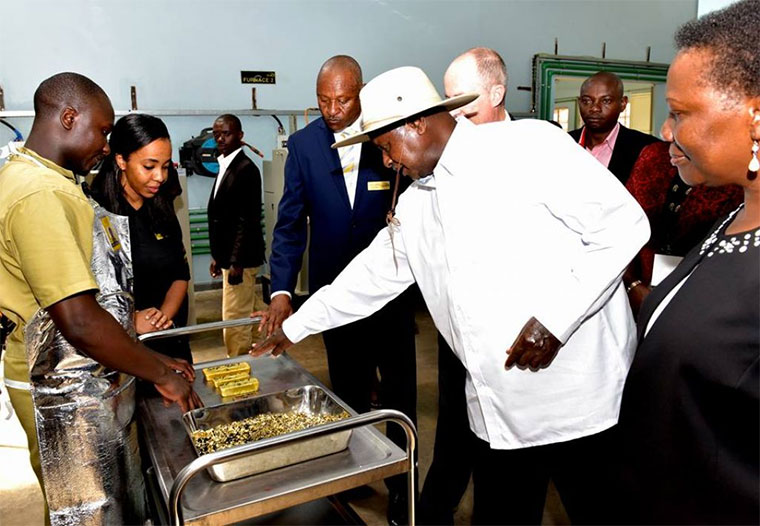
Large-scale mining is nascent but expanding. The Wagagai mine, inaugurated in 2025, processes 5,000 tonnes of ore daily, aiming for 1.2 tonnes of refined gold yearly—a 300-fold increase over previous capacities. Operated by Liaoning Hongda, it employs 3,000 locals and exports to China and the UAE.
Trading hubs like Kampala’s gold refineries, such as African Gold Refinery (AGR), process imported and local gold into bars meeting international standards. The UAE is the primary destination, absorbing over 95% of exports. Prices fluctuate with global spot rates, currently around $2,500 per ounce, but local buyers pay premiums for refined products.
Market dynamics include formal and informal segments. Formal trade requires licenses, with exports jumping tenfold from $201 million in 2022 to $2.3 billion in 2023, and further to $4.13 billion in 2023 data updates. Informal trade thrives due to porous borders, with smugglers evading taxes.
Investment opportunities abound. Foreign firms like Barrick Gold explore partnerships, while local companies offer gold bars for sale. For those searching “buy gold bars Uganda,” options include reputable dealers ensuring purity and compliance.
Technology is reshaping the market. Blockchain for traceability combats illicit flows, and mechanized tools boost ASM efficiency. Gold’s role in reserves is evident: Uganda’s total reserves, including gold, stood at $3.36 billion in 2018, but recent exports have bolstered forex.
Regional competition from Mali and Ghana influences Uganda, but its strategic location as a hub gives an edge. With gold prices high amid 2026 uncertainties, Uganda’s market is poised for sustained growth.
Current Gold Prices in Uganda
Gold prices in Uganda closely track the international spot price, which is currently around $4,596–$4,610 per troy ounce (with live spot at approximately $4,596 USD/oz based on recent market data). Local prices incorporate the prevailing USD/UGX exchange rate (around 3,541–3,605 UGX per USD) and may include small dealer premiums, especially for physical gold bars or jewelry.
Here is an updated summary table of approximate gold prices per gram in USD for common purity levels (based on the current global spot benchmark, converted and adjusted for typical market references in Uganda as of mid-January 2026). These are indicative spot/reference rates—actual dealer quotes in Kampala may vary slightly due to premiums, spreads, or local conditions:
| Purity (Karat) | Purity Level (%) | Price per Gram (USD) – Approximate Spot/Reference | Notes |
|---|---|---|---|
| 24K | 99.9% | $148 – $149 | Purest form, ideal for investment bars and bullion. Highest value; closest to international spot. |
| 22K | 91.6% | $135 – $136 | Common in jewelry; durable with alloy mix. |
| 21K | 87.5% | $129 – $130 | Popular in some regional markets for balanced jewelry. |
| 18K | 75.0% | $111 – $112 | Widely used in fine jewelry; more affordable with higher alloy content. |
| 14K | 58.3% | $86 – $87 | Lower purity, often for everyday wear; significantly cheaper. |
Regulations Governing the Gold Market in Uganda
Uganda’s gold market operates under a robust regulatory framework aimed at formalization, revenue generation, and sustainability. The cornerstone is the Mining and Minerals Act of 2022, which repealed the 2003 Act and introduced competitive licensing, environmental safeguards, and ASM integration.
Licensing is managed by the Directorate of Geological Survey and Mines (DGSM). Types include prospecting, exploration, retention, and mining leases. ASM miners must obtain artisanal mining licenses (AMLs), costing minimal fees to encourage formalization. Large-scale operations require environmental impact assessments and community consultations.
Export regulations are stringent. Exporters pay a 5% levy on refined gold and 10% on unrefined, plus a $200 per kilogram tax to curb smuggling. Importers need permits at $270, as per 2023 regulations. Value-added tax (VAT) applies, but exemptions exist for certified exports.
The government bans mercury in ASM, though enforcement lags. International standards like the Minamata Convention guide policies. To combat illicit trade, traceability systems require origin declarations.
Royalties are 5-10% based on mineral value, with revenues funding infrastructure. The Mining and Minerals (Licensing) Regulations 2023 and Export Levy on Refined Gold enforce compliance.
Challenges include enforcement gaps, but reforms like the 2024 guidelines on contraband gold aim to tighten controls. For buyers, compliance ensures ethical sourcing. Regulations make Uganda attractive for legitimate investors in “Uganda gold regulations.”
Economic Impact of Gold in Uganda
Gold’s economic impact in Uganda is profound, driving growth, employment, and fiscal revenues. In 2025, gold exports powered the mineral economy, contributing $5.8 billion—equivalent to 37% of total exports in prior years, now nearing 50%.
It bolsters GDP, with the mining sector growing 15% annually. Exports doubled year-on-year in October 2025, alongside coffee and oil. Forex inflows stabilize the shilling and build reserves.
Employment is massive: ASM supports 200,000-400,000 jobs, indirectly benefiting millions in supply chains. The Wagagai mine alone created 3,000 positions.
Fiscal contributions include royalties and taxes, though only $1.64 million in non-tax revenue from $2.3 billion exports in 2023 highlights leakages. Investments in infrastructure, like power and railways, are funded by gold revenues.
Regionally, Uganda’s hub status stimulates trade, but local benefits are limited as much gold is imported. Multiplier effects include boosted local businesses and tourism.
In 2026, gold’s impact could amplify with new mines, potentially adding billions to GDP.
Challenges in Uganda’s Gold Market
- Despite its promise, Uganda’s gold market faces hurdles. Illicit smuggling is rampant; much exported gold is from DRC/South Sudan, evading taxes and fueling conflicts.
- Environmental degradation from mercury use persists despite bans, causing health issues in areas like Kassanda. Deforestation and water pollution are acute in Amudat.
- Regulatory challenges include licensing delays and poor enforcement, encouraging informality. Access to finance for ASM is limited by collateral issues.
- Economic risks: Gold price volatility threatens reserves, as seen in BMI analyses for Uganda. Local communities see few benefits, with poverty persisting amid booms.
- Ethical concerns over conflict gold persist, despite traceability efforts.
- Addressing these requires stronger governance and international cooperation.
Future Prospects for Uganda’s Gold Market
Looking ahead, Uganda’s gold market brims with optimism. The Wagagai mine sets a precedent, targeting higher exports for infrastructure development. Discoveries like the 2025 gold rush position Uganda as East Africa’s hub.
Formalization reforms could unlock $12 trillion in value. Investments from China and others will boost production.
Global demand, amid economic uncertainties, favors Uganda. Diversification into value addition, like jewelry, enhances prospects.
By 2030, gold could contribute 10% to GDP if challenges are met.
Conclusion
Uganda’s gold market offers unparalleled opportunities for savvy investors. With its rich history, booming exports, and promising future, now is the time to act. We at Buy Cheap Gold Bars Africa Ltd invite you to partner with us for premium, ethically sourced gold bars at competitive prices.
Located in Kampala, we ensure compliance, purity, and seamless transactions. Don’t miss out—buy gold in Uganda today and secure your financial future with us!